Walking Tours
Home Page
Old Town San Diego
a walking tour by Carol Mendel
(Background history of Old Town...)
|
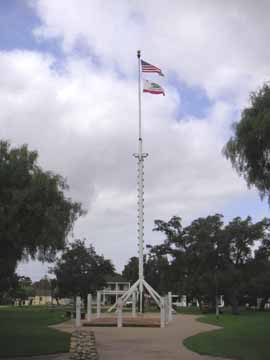
The central six blocks of Old Town are now Old Town San Diego State Historic Park. This walk covers the State Park, as well as the additional restored area just outside it.
In addition to this self-guided walking tour, you might enjoy the one-hour walking tour within the park boundaries that is given daily by the Park Service. These tours leave from the Visitor Center, beside the Plaza, at 11 a.m. and 2 p.m.
Distance: A mile. Time: At least half a day.
MAP of the walking tour
Terms of Use
|
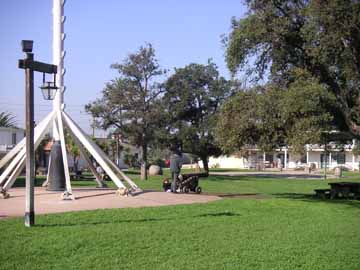
The plaza has been graced by several names, depending on which country had sovereignty over the town. For the Spanish, "plaza" was sufficient. When Mexico won its independence from Spain in 1821, the name became Plaza de Libertad ("Plaza of Liberty"). After the United States took over from Mexico, its name was changed to (what else?) Washington Square. Now it is again called simply "the plaza."
|
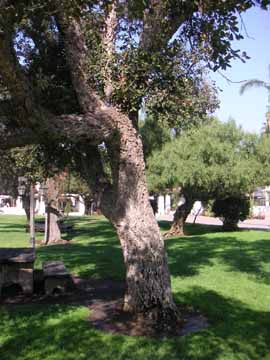
Go over to one and feel its corky bark. A cork oak lives from 300 to 400 years. After a tree is 20 to 30 years old, its bark can be stripped for cork once every ten years. As long as the stripper works carefully and does not bruise the tree, it will replenish its cork.
|
When you come out of the Visitor Center, walk left, around the plaza.
|
|
Walk to the left to the Blacksmith Shop and Woodshop, located on the site of stables built here in the 1860's.
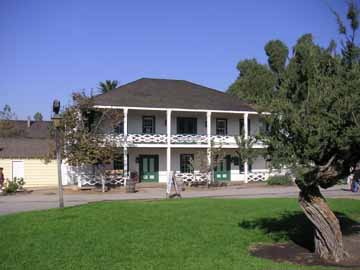
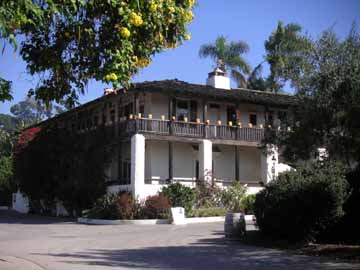
Return to the Cosmopolitan Hotel and turn left. You soon come to the entrance to the Seeley Stable Museum. In 1867, Alfred Seeley began a stage coach line carrying mail and passengers between San Diego and Los Angeles. The business lasted into the 1890's, when the growth of the railroad caused its decline and demise. It was Seeley who purchased the Bandini home, added the second story you see today, and converted the home into the Cosmopolitan Hotel. It served as his San Diego depot, with the stables behind it. Today the stable contains wagons, stage coaches, and artifacts from the Old West.
|
The Estudillos had eleven children, and various members of the family continued to occupy the house until 1887. Then the house came under the control of a "caretaker," who promptly proceeded to strip off and sell its furniture, tiles, locks, doors, and windows. What was left of the house was sold in 1905 to sugar magnate John D. Spreckels. Spreckels owned the streetcar line running down San Diego Avenue, and wished to attract more tourists to the area. He restored the home and named it "Ramona's Marriage Place," after the heroine of the enormously popular novel Ramona by Helen Hunt Jackson. The author supposedly based the character of Ramona on an adopted daughter of the Estudillo family.
The restored home is among the highlights of your Old Town walk.
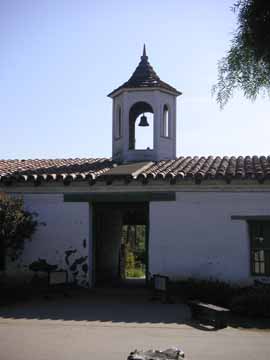
The construction of the home is especially interesting. The roof is of curved red tiles. In the early days, before molds, the workman shaped a tile by spreading the soft clay on one thigh. As soon as the clay dried enough to hold its shape, he lifted the tile off, set it aside, and began another one.
On top of his roof Estudillo built a cupola, so that he would have an excellent view of the events going on in the plaza.
Whenever you pass through a doorway, notice that the adobe walls are two to four feet thick. Since adobe is not strong, thick walls are needed to support a heavy tile roof. Note how the beams of the ceilings are lashed together with strips of rawhide. In those days, hides were cheap and metal was dear.
In the garden you will find the remains of a well shaded by a wooden pergola. This was only a decorative wishing well put in by Spreckels. In the Mexican times, Indian servants brought water to homes from local springs and the nearby San Diego River. (Dams upstream have now reduced the river to a trickle.)
When you come out of the Casa de Estudillo, walk left, and then left again. Just beyond the gardens of the Casa de Estudillo stands the last adobe built in Old Town, the 1868 Casa de Pedrorena. Miguel de Pedrorena was born to a prominent family in Madrid. His travels took him to England for an education at Oxford, then to Peru, and finally to San Diego as a supercargo, or shipping agent, of a coastal merchant ship. Once in San Diego, he married one of the daughters of Don José Estudillo, and added cattle-raising and two large ranchos to his business interests. This home was built by their son, Miguel, Jr.
Next door you will find Old Town's first frame building, which the Pedrorenas built in 1851 as a general store. Seventeen years later, two newcomers to San Diego used it to start a newspaper, The San Diego Union. After two years, the Union moved its offices to New Town, but in 1967 it reacquired the building and restored it to its 1868 condition. Inside you will discover the paraphernalia of early newspapermaking, as well as the office of the founders. Next to that is the Casa de Aguirre, a reconstruction of a home built in 1853.
|
|
|
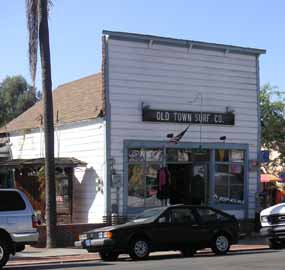
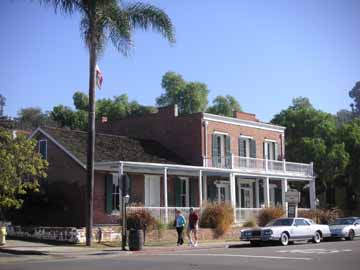
Thomas Whaley, a New England merchant, moved West to open general stores, first in San Francisco, and later in San Diego. He built this house for himself and his family in 1856. Its north room was originally a granary, but eventually Whaley remodeled it, and it became the County Courthouse in 1869. Two years later, a group who preferred that the courthouse be in New Town entered the house one night and took the county records. They transferred them uptown, where the records, and the courthouse, have remained ever since. The house is now restored and refurnished to the time it served both as County Courthouse and Whaley home.
Continue along San Diego Avenue. Normally you would now turn right on Conde Street, but if you want to take a break from the 19th Century and jump ahead to the 1950s for a short while, continue on San Diego Avenue until you reach the Old Town Model Railroad Depot.
Assuming you decided to visit the model railroad, you now retrace your steps back to Conde Street and turn left.
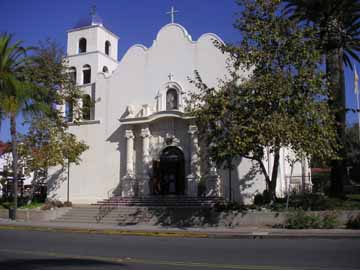
Half way down the block you will be standing in front of an adobe chapel. The building was constructed as a home in 1850. Eight years later, wealthy ranchero Don José Antonio Aguirre, in the midst of an important lawsuit, promised that if he won his suit he would provide Old Town with a church. He did win, and subsequently bought this adobe home and converted it into a chapel. For many years Father Antonio Ubach, who became Father Gaspara in the novel Ramona, was pastor here. Helen Hunt Jackson described this chapel as the site of the marriage of Ramona and Alessandro.
Continue along Conde Street, and turn right when you reach Congress Street. After two blocks, turn left at Twiggs Street.
|
Return to San Diego Avenue and turn left.
At the end of the block, look across Mason Street at the building now used by Threads of the Past. In 1872 this is where the terrible fire started that gutted the major portion of commercial Old Town. Today quilting and sewing demonstrations are given here.
|
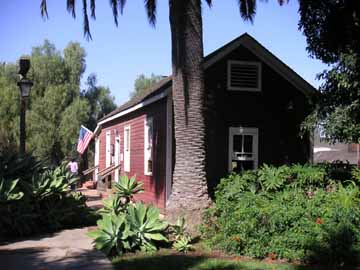
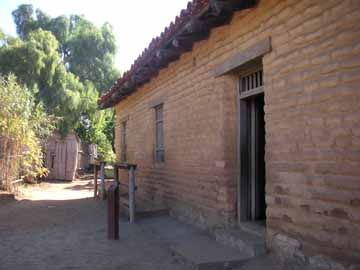
Go inside, sit down, and let the docent tell you about San Diego County's first public schoolhouse, and Mary Chase Walker, its first teacher.
|
Return to San Diego Avenue by the path between the buildings. On your left is a reconstruction of San Diego's first courthouse. Built in 1847, it burned down in the fire of 1872. Adjacent to the courthouse is the Wells Fargo & Company History Museum. The prime artifact on display here is a restored stagecoach.
Continuing down the block, the next building is the reconstructed Casa de Rodríguez, now used as a tobacco shop. The original one-story adobe was probably built in the early 1830's, and was also destroyed by the fire of 1872. Next to the Casa de Rodríguez is the Casa de Machado-Silvas, a home built about 1843. Today, the building is furnished as an early restaurant, in honor of a restaurant and saloon that opened here in 1854.
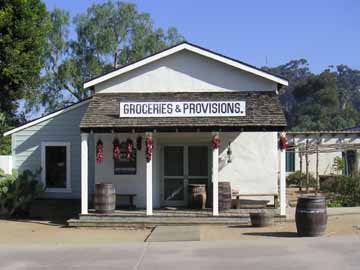
Continuing along this side of San Diego Avenue, you come to three more reconstructed buildings. The first is the U. S. House, a prefabricated frame house brought here in the spring of 1850. It was owned by Charles Noell and John Hayes, who operated it as an auction house and provisions store.
Next to the U. S. House are two adobe buildings. The San Diego House was built in the 1830's, and has been reconstructed to show how it looked in the late 1840's, when two free black men, Allen Light and Richard Freeman, used it for a provisions store and grog shop. Adjacent to it is the Machado-Wrightington House, once the home of Juana Machado Wrightington, another daughter of the Machado family, and her husband Thomas.
Return to top.
|
Enjoy this walking tour?
Check out the others in this series Balboa Park Cabrillo National Monument Downtown San Diego The Embarcadero La Jolla La Playa Mission Bay Park Mission Beach Old Town Shelter Island Sunset Cliffs |
Enjoy full-color illustrated maps? Check out the ones below. Some can be purchased as laminated maps, some as folded maps, some as wooden trays, and some as all three. San Diego Los Angeles Palm Springs Santa Barbara San Francisco Bay Area Las Vegas Salt Lake City Oregon Washington DC |