|
San Diego
walking tours home page |
Balboa Park
walking tours home page |
Balboa Park:
The El Prado Area
a walking tour by Carol Mendel
Distance: A mile. Time: Several hours or more, depending on how many museums and galleries you visit.
Terms of Use
The El Prado area of the park is known for its museums and Spanish Colonial architecture. The architectural style was adopted for the Panama-California Exposition held here in 1915-1916. (More about the 1915-1916 exposition...) The self-guided walking tour begins at what was the exposition's main entrance, off Laurel Street.
|
Now you are ready to begin the walking tour.
|
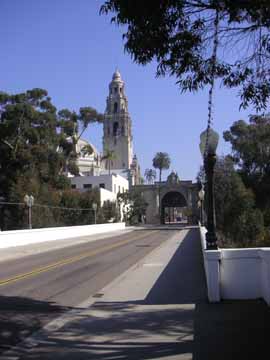
Walk across the bridge on the right side, which gives you a better view of the buildings behind the gate. The architectural effect is intended to suggest the Spanish city of Toledo, which also has a long bridge leading to a low entrance gate. As you approach the gate, the building on your left was the Exposition Headquarters.
|
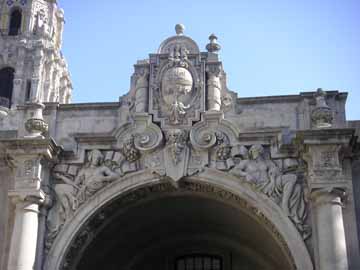
Above the gate on the left you can see the California Tower and the dome of the California Building, both decorated in inlaid blue, green, gold, black, and white ceramic tiles.
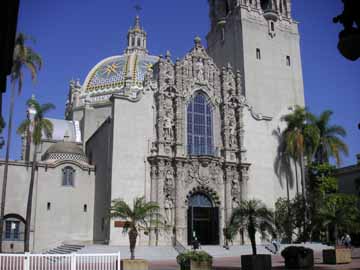
Walk under the arch on the right side, into the Plaza de California. Except for the Organ Pavilion, the buildings of the Plaza de California were the only exposition buildings built to be permanent. On your left is the California Building, built by the State of California. The design of its facade is taken from that of the Cathedral of Mexico in Mexico City. View it from the shade of the arcade across the plaza. In true Spanish Colonial style, it juxtaposes plain flat facades with areas of elaborate ornament.
Walk under the arch on the right side, into the Plaza de California. Except for the Organ Pavilion, the buildings of the Plaza de California were the only exposition buildings built to be permanent.
|
The statues and busts of the facade are figures from the early history of San Diego. (More about the facade...)
To the right of the California Building, the California Tower rises 200 feet. At its top is a weather vane in the shape of a Spanish ship similar to Cabrillo's. Inside the tower, a 100-bell symphonic carillon plays the standard Westminster chimes every quarter hour and a five minute recital at noon. The bells are operated from two keyboards on the third floor of the California Building. Usually they are played automatically with reels similar to those of a player piano. Occasionally, however, a carillonneur presents a live recital.
With the help of the Smithsonian Institution, the School of American Archaeology, and other groups, the State of California provided the California Building with exhibits ranging from the pueblos of the Southwest to the Aztec and Mayan ruins of South America. Expeditions to these places returned with over 5000 specimens of pottery, clothing, and religious and decorative items. After the exposition, these collections became the foundation of the San Diego Museum of Man, which now occupies the building. The museum's collections have grown over the years and specialize in the anthropology and archaeology of the Indian cultures of the Americas.
Adjacent to the museum is a gift shop that carries jewelry and imported goods from countries all over the world.
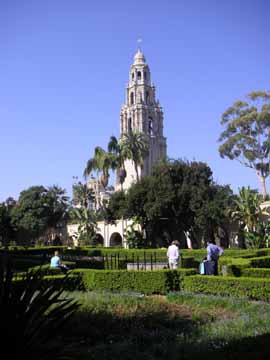
Across the plaza from the California Building, the City of San Diego built a low building in the style of the missions set up in California by Father Serra. You are currently standing in its arcade. To see the building better, you need to cross the plaza and look back at it by standing in front of the Museum of Man. To cross the plaza safely, return to the pedestrian crosswalk you passed just before you walked under the arch of the West Gate.
|
Returning from the gardens to the arcade, you are at the House of Charm, reconstructed to duplicate one of the buildings put up for the 1915-1916 Panama-California Exposition. The original, "temporary" building lasted almost eighty years, although by then it was seriously deteriorated. It was torn down in 1994, to be replaced by a nearly-identical, permanent one. Later, from the other side of the Plaza de Panama, you will be better able to see its simple Spanish Mission style of architecture. (Its present name, the House of Charm, comes from its use during the 1935-1936 exposition, when souvenirs and gifts were sold there.)
Today the building houses two major tenants. The San Diego Art Institute features the works of San Diego County artists. The Mingei International Museum features traditional and contemporary folk art, craft and design.
Follow the arcade around to the right along the west side of the Plaza de Panama. At the end of the arcade you have an excellent view of the Spreckels Organ Pavilion. (More about the Spreckels Organ...)
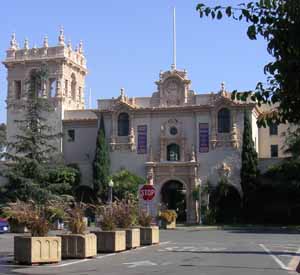
On your way across the Plaza de Panama to the arcade on the opposite side, stop at the 1927 bronze sculpture of El Cid Campeador ("The Valiant Military Leader") by Anna Hyatt Huntington. El Cid, otherwise known as Rodrigo Díaz de Bivar, was a legendary medieval hero of the 11th Century. An ardent supporter of Christianity, he helped to drive the Moors from Spain. Two other statues of El Cid were made from the same mold -- one stands in the court of the Museum of the Hispanic Society in New York City; the other is in Seville, Spain.
|
This building was torn down and reconstructed in 1995-1996. As part of the process, more than 1000 of the original doors, windows, fixtures, and other architectural pieces were removed, restored, and eventually reinstalled on the new building.
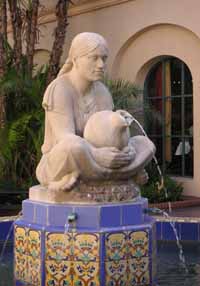
Enter the arcade of the building, follow it to the left, and soon you will come to the entrance to a courtyard in the center of the building. Designed after the Museum of Guadalajara, Mexico, the courtyard is surrounded by Spanish arcades.
|
Behind the arcades are numerous meeting rooms that are rented to the public. On the north side of the courtyard, the Balboa Park Visitors Center contains brochures and information about attractions in both Balboa Park and the San Diego area.
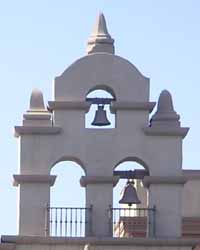
On the south side, you will find a restaurant, whose dining room overlooks a patio and small formal garden behind the building. In the summer months, meals are served on the patio. The garden closely resembles the one at a palace in Rhonda, Spain.
|
Continue along the arcade, turn right, and proceed along El Prado.
|
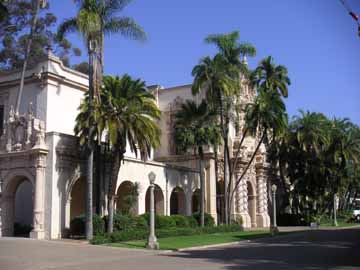
As you walk along the arcade, the next building you come to is the Casa de Balboa. This building was not as fortunate as its neighbor on the other side of the street. It too had been scheduled to be torn down and rebuilt. In early 1978, however, while plans were being made for its replacement, the building burned to the ground. The building has now been rebuilt to be identical in appearance to the former one.
The Casa de Balboa now houses three museums. The Museum of Photographic Arts features exhibits of photography that change approximately every six weeks. The San Diego History Center contains exhibits about the history of the San Diego region. The History Center's research archives, open to the public, are downstairs. Also downstairs is the San Diego Model Railroad Museum, home of an elaborate miniature railroad system.
Immediately after you pass the Casa de Balboa, you reach a spot where some steps lead down a path lined with low stone walls to a quiet shady glen, an excellent spot for a picnic or snack.
|
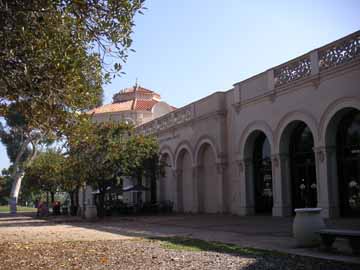
The Science Center offers a large variety of exhibits in which visitors are invited not just to look, but to touch, talk, and listen as they learn. It also houses an IMAX film theater. The building is open daily, with hours varying with the season. Unlike most of the attractions in Balboa Park, it is open evenings, providing a place to go when the other attractions are closed.
|
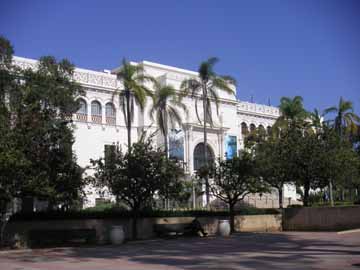
Returning toward El Prado, walk to the right along Village Place. Behind the Natural History Museum, a large lawn lies under the spreading arms of a Moreton Bay fig tree from Australia, planted here in 1915. Although the Moreton Bay fig is one of the many varieties of rubber tree, it is not the one commercially used for rubber.
|
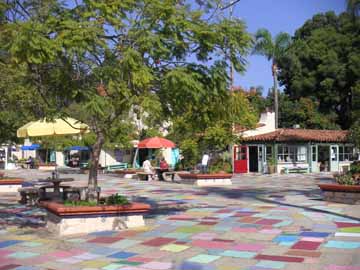
When you have finished watching the artists at work, and are through surveying their wares, leave the Spanish Village by the entrance you came in, and begin walking back on the other side of Village Place. Now you will have a close-up view of the statuary and ornate decoration on the east side of the Casa del Prado. The design of the east entrance is taken from entrances to the two chapels that flank the Cathedral of Mexico in Mexico City. Just before you reach El Prado, you pass a facade of statuary. Before the old building was razed, its statuary and decorations were carefully removed and saved. From them, molds were prepared, and from these molds, new statues and decorations were cast.
Continue under the arcade, along El Prado. Now you can get a good look at the Casa de Balboa, the new building built to duplicate the one destroyed by fire. The original building was constructed to house the exhibits of Canada during the 1915-1916 exposition. It was based on the Town Hall of Palma de Majorca, capital of Spain's Balearic Islands. Above each entrance, sculpted female figures form the caryatids that support a large overhanging roof. Below the buttresses, iron railings guard the balconies of ornate windows.
|
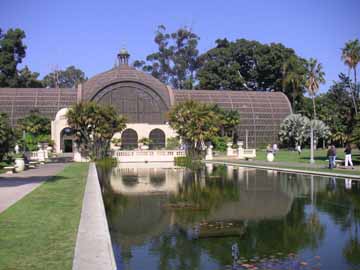
Reflected in the Lily Pond is the Botanical Building. The iron skeleton of the building was originally scheduled to be a Santa Fe railroad station, but the exposition bought up the disassembled building and set it up here to house botanical displays. Over twelve miles of redwood lath form a lattice over the iron skeleton. Inside, you will find over 500 species of tropical and subtropical plants, as well as seasonal flower displays.
When you come out of the Botanical Building, follow the walkway to the right. Pass beside the fountain and between the buildings of two art museums to the Plaza de Panama.
On your left is the Timken Museum of Art. Built in 1965 of imported Italian travertine marble, this modern building houses paintings by Old Masters, in addition to a collection of Russian icons.
|
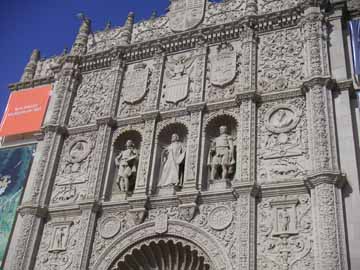
Appropriate to an art museum with 17th Century Spanish architecture, the entrance facade is decorated with sculptures of 17th Century Spanish painters. From left to right they include a bust of Ribera, full statues of Velásquez, Murillo, and Zurbarán, and a bust of El Greco. (The museum collection includes works by all five of these painters.) In arches above the windows of the plain facade, bas reliefs depict various arts. Inside, the design of the rotunda reflects the Hospital of Santa Cruz in Toledo. The handsome staircase featuring blue tiled handrails leads the eye upward toward a decorated wood ceiling.
In 1966 a wing was added to the west side of the museum. Its contemporary styling is flavored with Spanish and Moorish touches. The new wing now features a cafe in its courtyard.
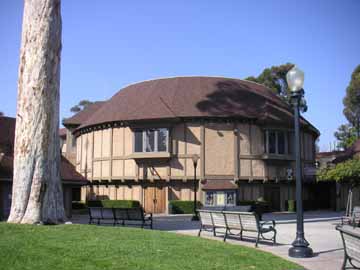
When you come out of the museum, walk past the new wing and turn right on El Prado. Just beyond the sculpture garden, before you reach the California Tower, take the path to the right. It leads to The Old Globe, a complex of three theaters.
|
To the right of the Old Globe is the Sheryl and Harvey White Theatre, a theater-in-the-round. And to the right of the Carter, nestled in a canyon, is the outdoor Lowell Davies Festival Theatre.
From December through May, the Globe and White theaters present six plays, including both contemporary and classic. During the summer season, from June through October, the three theaters present another six plays, including at least one by Shakespeare. Ninety-minute tours of the theaters, including the backstage facilities, scene shops, and costume rooms, are given on weekends. Check the website for details. At any time, this is a pleasant spot to sit down, enjoy a view of the California Building and Tower, and relax.
Return to top.
|
Enjoy this walking tour?
Check out the others in this series Balboa Park Cabrillo National Monument Downtown San Diego The Embarcadero La Jolla La Playa Mission Bay Park Mission Beach Old Town Shelter Island Sunset Cliffs |
Enjoy full-color illustrated maps? Check out the ones below. Some can be purchased as laminated maps, some as folded maps, some as wooden trays, and some as all three. San Diego Los Angeles Palm Springs Santa Barbara San Francisco Bay Area Las Vegas Salt Lake City Oregon Washington DC |